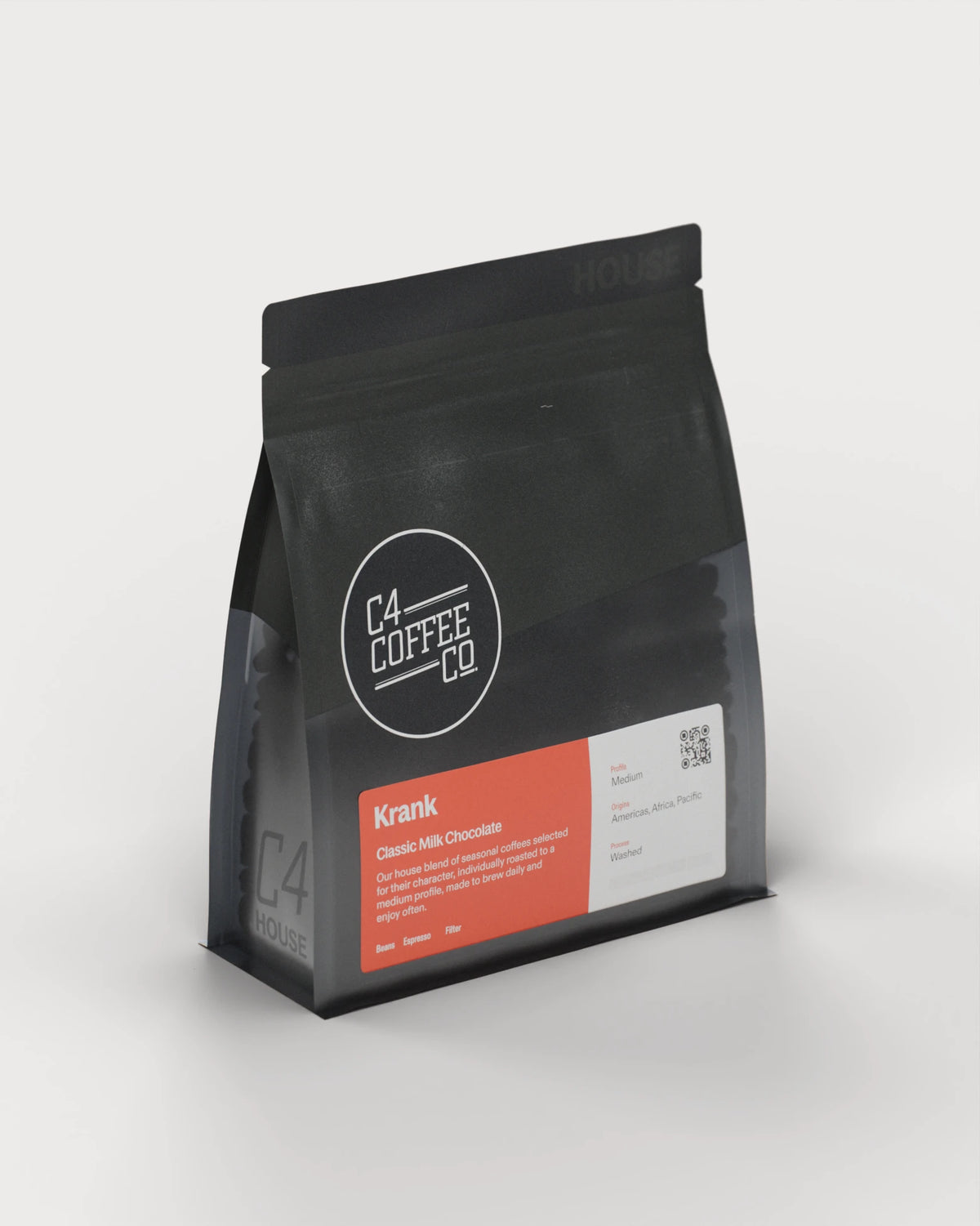
New bags. Same coffee.
Why the change?
What's inside hasn't changed: the same coffees, from the same farms, roasted the same way in Ōtautahi. What has changed is the bag, its label, and how we group and describe our coffees.
Our range keeps growing. So each coffee now goes in one of four bags, coloured by what leads the cup, and is described the same way everywhere, which keeps every one of them easy to find.
-

House
Roasted for espresso, with a noticeable impact from the roast and an approachable palate? Then it goes in a black House bag.
-

Modern
Roasted to bring out more complexity, with minimal flavour from the roast, but still made for espresso or a batch brew with a bit more body? Then it's in a white Modern bag.
-

Clarity
A rare variety that relies on the flavour of the coffee itself, processed only to bring out those notes, with little to no flavour from the roast? Then it's in a champagne Clarity bag.
-

Vibrant
Was it the processing that gave the coffee most of its flavour? Then it's in a pink Vibrant bag.


The label tells you how it tastes.
We cup every coffee and list its notes strongest first. They start from the SCA flavour wheel, then get more specific: the words that fit this coffee, tasted the way it's meant to be brewed.
Each note has its place on our wheel, in its family, and the label takes the colour of the lead note's. Krank leads with chocolate, so its label is red.
Point at a coffee to see where its notes sit on the wheel.
KrankHouse
The most prominent note we tasted was chocolate, in cocoa.
HuilaModern
The most prominent note we tasted was chocolate, in cocoa.
El Oasis Pink BourbonClarity
Brewed as filter, the most prominent note we tasted was orange blossom, in citrus.
Blackberry SorbetVibrant
Brewed as espresso, the most prominent note we tasted was blackberry ice-cream, in fruity.
All our flavour families
- Cocoa Dark Chocolate, Milk Chocolate, Cacao Nib, Hazelnut
- Smoky Tobacco, Cereal, Toasted, Ashy
- Floral Jasmine, Rose, Chamomile, Black Tea
- Fruity Berry, Dried Fruit, Tropical, Stone Fruit
- Citrus Lemon, Orange, Grapefruit, Lime
- Sweet Caramel, Honey, Brown Sugar, Vanilla
Why plastic?
Every paper coffee bag needs a lining to keep the coffee at its best, and that lining is almost always plastic. Bonded to paper, it makes a mixed material that can't be separated or reprocessed, whatever the bag says.
Ours is one soft plastic throughout, which is exactly what soft-plastic recycling is made for. When it's empty, drop it at a soft-plastic recycling point, at C4 HQ, or at some of the cafés that pour our coffee.
No coffee by that name. Try a tasting note, or ask us.
Transparent by nature.
We share what we can find out about every coffee: who grew it and where, how it was processed, what's in each blend and why we chose it. With the new bags we've taken that literally: what you see is the coffee itself.
Coming into 2027 and our thirtieth year, we want to go further, and make it easier to see how and why we do what we do, one step at a time.
Clear, and kept at its best.
The bag's tint cuts down the light that harms coffee, so you can see what's inside while it stays at its best. Keep it somewhere cool and dark, as you would any coffee.
Then give it time to rest: about two weeks for espresso, four for filter. Pop in your roast date to see when yours is ready.
Espresso
Resting for 14 days, then at its best
Filter
Resting for 28 days, then at its best
We roast in small batches through the week. Your coffee is at its best inside the window above, and still good after it, just quieter.
To keep it longer, freeze it: vacuum-sealed, or in our bag with tape over the valve. Keep it dry, and take it out only when you're ready to defrost and use it, since each time out lets in moisture.